I've lost count of how many times someone has looked at me and said, "You feel like you're from another time." Not in a mystical, time-traveler sense — more like I wandered in from a different decade and forgot to change.
Maybe it's the way I dress, ricocheting between a pressed-waist 1950s housewife fantasy and the glittery bravado of a 1970s go-go dancer. Or maybe it's my chin-length bob, curled weekly into something Elizabeth Taylor might have approved of — soft, deliberate, slightly dramatic. Whatever the reason, I've come to realize that faces, like clothes, carry eras inside them. Some people wear them effortlessly. Others — like me — seem to echo a past we never lived in.
Faces Have Fashion Histories, Too
We talk endlessly about vintage style, retro silhouettes, and throwback trends, but rarely about the idea that a face itself might belong to a different aesthetic moment. Yet certain features feel unmistakably tied to specific eras: the sculpted brows of the 1940s, the doe-eyed softness of the 1960s, the sharp cheekbones and defiant gazes of the 1990s.
It's not about beauty standards — it's about visual language. Every era favors a different kind of face, just as it favors different hemlines or hair lengths. Some faces thrive under the geometry of a sleek bob; others bloom under waves, volume, or barely-there makeup. And sometimes, the modern world simply doesn't know what to do with a face that longs for a different frame.
The Romance of Being Slightly Out of Step
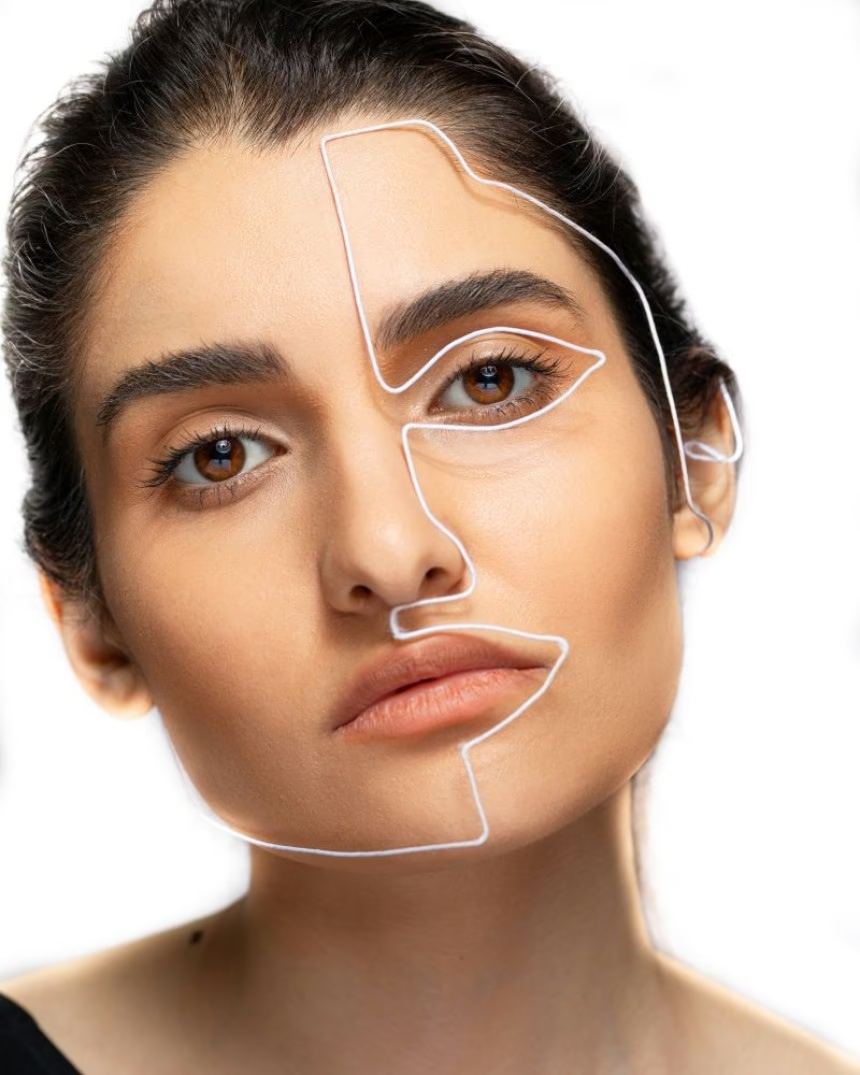
There's something quietly liberating about not fully belonging to the present moment. When your face feels borrowed from another decade, you stop chasing trends so aggressively. You start dressing for yourself — for the mirror, not the feed.
That might mean red lipstick when everyone else is contouring. Curls when the algorithm favors blunt, glassy hair. Silhouettes that feel nostalgic rather than algorithmically "new." It's not rebellion. It's alignment.
Style as Translation, Not Reinvention
If your face feels like it belongs to another era, the goal isn't to force it into modernity. It's to translate it — softly, respectfully — into the present. That might look like pairing vintage-inspired hair with contemporary tailoring, or balancing classic makeup with relaxed, modern skin.
The magic happens in the middle space: where Old Hollywood glamour meets today's ease, where a past aesthetic learns to breathe in modern light.
So, What Era Is Your Face?
Maybe your features whisper flapper mischief. Maybe they hum with disco confidence. Maybe they glow best in the candlelit softness of another century altogether.
Whatever the answer, there's no need to correct it. Some faces are meant to be timeless. Some are meant to be slightly out of sync. And some lucky ones carry the quiet poetry of another era, just beneath the skin.
Practical Tips
- If you feel drawn to a particular era, start by incorporating one element at a time — a signature lip color, a hairstyle detail — rather than committing to a full retro look.
- Balance vintage-inspired elements with modern pieces to keep the overall effect feeling intentional rather than costumey.
- Pay attention to what makes you feel most like yourself, not what the algorithm or current trends are promoting.
- Experiment with different makeup approaches from different eras — a 1940s brow, a 1960s eye, a 1990s lip — to discover which one resonates most naturally with your features.
Conclusion
Style becomes most powerful when it stops chasing the present and starts honoring something deeper. If your face feels like it belongs to a different era, lean into it. Translate it gently into the now. The most captivating looks are rarely the ones that fit perfectly into their moment — they're the ones that carry the quiet poetry of somewhere else entirely.
FAQ
Q: How do I know which era my face belongs to? Look at vintage photographs or films and notice which faces you're most drawn to — or which features people consistently comment on when they describe your look. The era that keeps surfacing in your instincts or in others' observations is often the one your face naturally echoes.
Q: Can I dress for a different era without looking like I'm wearing a costume? Yes — the key is translation, not replication. Pair one or two era-inspired elements (a hairstyle, a lip color, a silhouette) with contemporary pieces to keep the look grounded in the present.
Q: Why do some faces feel tied to specific decades? Every era has a distinct visual language shaped by the beauty standards, photography, and cultural aesthetics of the time. Certain facial features — brow shape, bone structure, eye placement — align more naturally with the proportions and styling preferences of particular periods.
Q: Is it possible to have a face that belongs to no specific era? Absolutely. Some faces are genuinely timeless — they don't read as belonging to any particular decade, which can be a unique strength in its own right, allowing for great versatility in styling.